


The Cadillac DeVille; A True Classic
- Craig McPherson
- Dec 21, 2025
- 5 min read
By: Craig McPherson
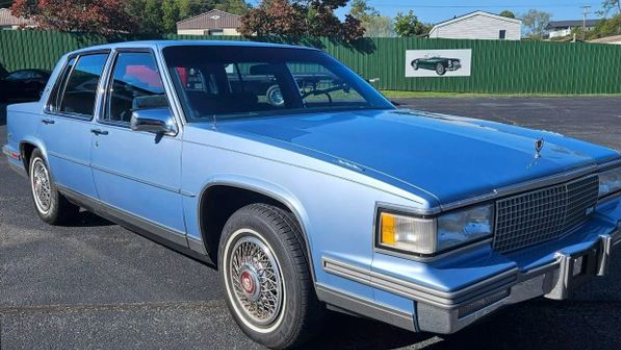
A 1987 Cadillac DeVille, complete with a light blue paint job, and intricate chrome details
around its boxy, yet elegant body. (Credit : Cadillac DeVille - 6th Gen Market - CLASSIC.COM)
The Cadillac, one of the oldest luxury car brands in the world, was beloved in older decades, especially the 1950s and 60s. While the Cadillac was responsible for significant models, such as the Eldorado or the Escalade, the DeVille has a particularly fascinating history. This is the story of the Cadillac DeVille, one of the most innovative American luxury cars.
The original prototype of the DeVille debuted at the 1949 Motorama Show. This special model, owned by General Motors President Charles E. Wilson had a special chassis, a dummy air scope, and even power windows and a telephone. The most early models of the DeVille were Series 62 Coupes, until a Sedan counterpart was created in 1956.
The DeVille would gain more distinguished features, such as lady tail fins and bullet-shaped headlights in 1959. The first 5 generations of the DeVille were designed by Bill Mitchell. Mitchell also had a hand in the designs of a few other popular cars, such as the Cadillac Sixty Special, the 1963 Corvette, and the Camaro.
The first generation of the DeVille, lasting from 1959 to 1960, was designed with 6.4L V8 engines and General Motor’s famous 4-speed Hydra-Matic automatic transmission. However, the 1960 DeVille would see some notable changes compared to the 1959 DeVille. These changes would include a full-width grille, as well as a lack of front bumper guards and some chrome.
The second generation, models made from 1961 to 1964, would see even more significant changes. These would include the grille being slanted back towards the bumper, between the dual headlights. Furthermore, there were added power brakes and steering, automatic transmission, and a new 7.0L V8 engine. In addition to all of this, a few of the DeVille’s most notable cosmetic features would be changed. One of these would be the large fins behind the cab. This was most likely due to the general trend of fins on luxury cars ending. Another car that went through a similar transition would have been the Chevrolet Bel Air, another classic luxury car that would also lose its fins during the mid-sixties.
The DeVille’s third generation began in 1965. Notable features that were changed this year included headlight pairs that were vertical instead of horizontal, as well as a wider grille. 1966 would see the introduction of variable ratio steering, headrests, reclining seats, and an AM/FM stereo system. 1969 would be a particularly notable year for the DeVille, as this year’s model was made to be longer, lower, and wider. It was meant to resemble the popular 1967 Fleetwood Eldorado. The 1969 DeVille would become one of the most popular cars that Cadillac would ever make, with exactly 163,048 models built.
The fourth generation of DeVille’s began in 1971. This would be a notable year for General Motors as a whole, as all of the company’s cars faced significant redesigns this year. The Cadillac DeVille was no different, in fact, the new version of the car for this era would have a record-breakingly wide interior. The spaciousness of this new interior would go unmatched until the early to mid 1990’s. In 1974, a new, optional feature would be introduced. This feature was the “Air Cushion Restraint System”. This feature was essentially just the inclusion of airbags, large inflatable bags that would pop out from the dashboard to protect both the driver and passengers in the case of a frontal collision. However, this feature was deemed too expensive by customers, resulting in it becoming popular. The Air Cushion Restraint System would be discontinued by 1976.
The beginning of the DeVille’s fifth generation would be in 1977, where the luxurious coupes were given higher rooflines and larger trunks. These newer models had to be smaller and lighter to improve their fuel economy. In 1980, the 7 liter V8 engine had been replaced by the new 368 CID V8, a 6 liter engine. This unfortunately meant that these DeVille’s were somewhat weaker and slower. Overall, 1980 was a very troubling year for the auto industry as a whole. Due to a financial recession, and the oil crisis of the 1970s. Many of the big companies, including General Motors, struggled to meet the taxing demand for smaller, more fuel efficient cars. They could only sell less than half the amount of Cadillac DeVilles that they had sold in the previous year.
The design changes made during the sixth generation, from 1985 to 1993, were conceived by designer Irvin Rybicki. The luxury coupe had been made even smaller, and was made to be even more fuel efficient. New features added in 1986 would include an anti-lock brake system, which stopped the wheels from locking up and skidding whenever the driver would brake, as well as a factory-installed cellphone. The 1989 model would receive a notable makeover. Consumers thought its new appearance was much more grand, not as stubby as the DeVilles made from 1985 to 1988. It also had electric outer mirrors, an airbag, a heated windshield, and a cassette stereo player.
The seventh generation began in 1994. The new designer of the DeVille was Chuck Jordan, who was guided by design director Wayne Cherry. This generation was the first where the DeVille was only available as a four door sedan, not a two door coupe. In 1997, the DeVille would lose its rear wheel skirts, making the design look more rounded.
Wayne Cherry would take Chuck Jordan’s place as the DeVille’s designer for the eighth, and final, generation. The exterior was redesigned once more, to be more aerodynamic. It also gained night vision, a feature that allowed for there to be thermal projections of the road ahead on the dashboard. These were meant to help drivers stay aware of any nearby pedestrians or animals at night, but it was discontinued by 2004. Not too long after, in 2005, production of the DeVille would cease. The DeVille had been replaced by the De Ville Touring Sedan, or DTS. This was due to how Cadillac wanted to rebrand its image, making more modern looking luxury cars appealing to more younger people than older people, who had become commonly associated with the vintage coupes.
In conclusion, the Cadillac DeVille would be one of the most influential automobiles in the world of American luxury. While it would have to sacrifice many of its signature characteristics to not be seen as outdated, designers would still do their best to preserve its original charm, while making new innovations. Even though the DeVille eventually faced retirement in 2005, it’s still beloved by vintage car enthusiasts to this day. As a speaker from the Mergata museum in Ocean Cadillac said best, the Cadillac was “a symbol of optimism, luxury, craftsmanship, and the standard of American prestige.”


Comments